Chapter 1 of 8
1Deadlines and scope
Connected tools, machines, building devices and trackers developed today will reach a single market whose rules change fundamentally by December 2027. Five EU acts cover every one of these products by then, and the vulnerability reporting duty has applied since September 2026, also to devices in the field. Harmonised standards are still missing. We estimate that 1,750 to 3,440 makers in DACH are affected, and few of the surveyed firms are ready. The chapter sets out the dates and the scope of each act and shows where the standards and the manufacturers stand.
1.1 Connected devices in DACH
Germany’s mobile networks carried 86.1 million machine-to-machine (M2M) SIM profiles at the end of 2025, 17 % more than a year earlier.78 That is about four fifths of the 106.4 million other active SIM profiles.78 Austria counted 27.5 million M2M SIM cards at the end of 2025, twice the 13.8 million other SIM cards in use and more than three times the 8.4 million of the end of 2021. Some of them work in devices abroad.337, 338 In Switzerland, M2M subscriptions rose by 14.3 % to 5.2 million in 2024, while mobile subscriptions overall grew by 2.5 %.48
These counts cover only devices on mobile networks. Tools and building devices that connect over BLE or Wi-Fi come on top. Worldwide, Ericsson counts 22.3 billion Internet of Things (IoT) connections at the end of 2025, of which 4.5 billion, about a fifth, are cellular.134 Ericsson expects the total to more than double to 47.1 billion by 2031.134
1.2 From reporting duties to full application
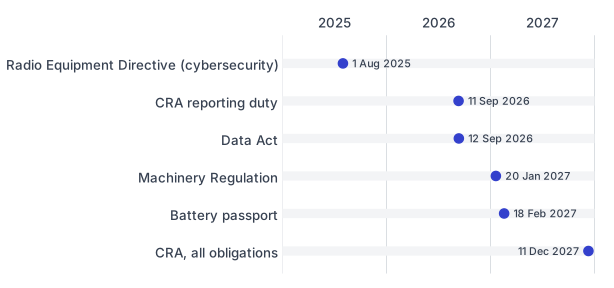
Vulnerability reporting under the Cyber Resilience Act (CRA) has applied since 11 September 2026, the Machinery Regulation applies from 20 January 2027 and the full CRA from 11 December 2027.167, 168, 171 Five legal acts set the pace: the CRA,171 the Data Act,170 the Machinery Regulation,168 the cybersecurity delegated act under the Radio Equipment Directive (RED)141 and the Batteries Regulation with its battery passport.169 All five are regulations. They apply directly in Germany and Austria without national transposition, and to products from Switzerland as soon as those are placed on the EU market. Three of the six deadlines already apply, and the full CRA comes last (Figure 1). A product whose development starts now and which ships in 2028 has to meet all five acts at once.
A corrigendum moved the Machinery Regulation date from the original 14 January.167 After an amendment, the RED delegated act has applied from 1 August 2025, one year later than first adopted.145 Five of the eight application dates have passed, and the full CRA comes last (Table 1).
| Date | Act | Obligations that apply | Products in scope |
|---|---|---|---|
| 1 Aug 2025 | RED Delegated Reg. 2022/30 | Essential requirements on network protection, personal data and fraud | Radio equipment placed on the market from this date |
| 12 Sep 2025 | Data Act | General application: pre-contract information, user and third-party access rights, contract rules | Connected products and related services in the EU |
| 11 Jun 2026 | CRA | Rules for notifying conformity assessment bodies | Notified bodies and authorities |
| 11 Sep 2026 | CRA | Reporting of actively exploited vulnerabilities and severe incidents | All products with digital elements on the market, including those placed before 2027 |
| 12 Sep 2026 | Data Act | Access by design and by default | Connected products placed on the market after this date |
| 20 Jan 2027 | Machinery Regulation | Full application; Machinery Directive 2006/42/EC repealed | Machinery and related products placed on the market from this date |
| 18 Feb 2027 | Batteries Regulation | Battery passport, QR code on all batteries, end-user removability of portable batteries | Batteries and products incorporating them placed on the market from this date |
| 11 Dec 2027 | CRA | Essential requirements, conformity assessment, CE marking | Products with digital elements placed on the market from this date |
11 September 2026, CRA reporting. Article 14 applies fifteen months before the rest of the regulation.171 An actively exploited vulnerability or a severe incident requires an early warning within 24 hours and a notification within 72 hours.171 Both go through ENISA’s Single Reporting Platform, which has run since 11 September 2026.133, 156 The final report is due 14 days after a fix or mitigation is available, or for a severe incident one month after the notification.171 Reports go to the CSIRT acting as coordinator in the Member State of the main establishment, and ENISA receives them at the same time.171 Impacted users must be informed, where appropriate in a structured, machine-readable format.171 Open-source software stewards report only from 11 December 2027.156
The duty also covers products placed on the market before 11 December 2027.171 It applies today to a tool sold in 2023 that is still in the field.
12 September 2025 and 12 September 2026, Data Act. Access by design and by default covers only products placed on the market after 12 September 2026.170 The user’s rights to obtain data and to have it shared with a third party, by contrast, have applied since 12 September 2025 without a cut-off date for placing on the market. They therefore reach the installed base as well.170
11 June 2026, CRA notified bodies. Member States have been able to notify conformity assessment bodies under the CRA since 11 June 2026.171 No body has been notified under the CRA so far.161 Germany has registered the BSI as its notifying authority, Austria has registered none.161
20 January 2027, Machinery Regulation. The Machinery Regulation replaces the Machinery Directive 2006/42/EC on this date.167, 168 Machinery placed on the market under the Directive before that date may still be made available afterwards.168 The essential requirements on protection against corruption and on the safety and reliability of control systems are new for connected machinery.168
18 February 2027, batteries. Batteries for light means of transport (LMT), industrial batteries above 2 kWh and electric-vehicle batteries placed on the market from this date need a battery passport with data on the individual battery, including data from its use.169 All batteries need a QR code, and products with portable batteries must let the end-user remove and replace them.169
1.3 Scope and exemptions
None of the exemptions takes a typical tool, machine, building device or tracker out of scope. The CRA excludes medical devices, vehicles, aviation, marine equipment and defence.171 The differences between products lie in the detail of each act.
CRA. The CRA covers products with digital elements whose intended or reasonably foreseeable use includes a direct or indirect data connection to a device or network.171 Apart from the reporting duty, legacy products fall under the CRA only if they are substantially modified once it applies in full.171 EU type-examination certificates issued for cybersecurity requirements under other Union harmonisation legislation remain valid until 11 June 2028.171
RED delegated act. Since 1 August 2025, radio equipment that can reach the internet must protect the network.141 It must also protect personal, traffic and location data where it processes them.141 The act counts communication “via any other equipment”, so a Bluetooth tool that reaches the cloud through a smartphone app is covered.141 Medical and IVD devices are excluded from all requirements, and products under the aviation, vehicle type-approval and road-toll legislation only from data protection and fraud protection, not from network protection.141 Delegated Regulation 2026/339 repeals the act with effect from the day the CRA applies in full.154 From then on a radio product answers to one cybersecurity regime, the CRA, instead of two.154 Radio equipment placed on the market up to 10 December 2027 remains subject to market surveillance against the requirements of the delegated act.154
Data Act. A connected product is an item that “obtains, generates or collects data concerning its use or environment” and can communicate them, and “whose primary function is not the storing, processing or transmission of data on behalf of any party other than the user”.170 The access obligations of Chapter II do not apply to micro and small enterprises without large partner or linked enterprises. They reach medium-sized enterprises one year after they qualify as such or one year after placing a product on the market.170 A small enterprise employs fewer than 50 persons, a medium-sized one fewer than 250.138 Makers with 100 or more staff therefore gain at most one year’s grace per product.170 The Commission’s Digital Omnibus proposal of 19 November 2025 would amend the Data Act. At the time of publication it is at first reading and not adopted.153, 174 The text in force applies.
Machinery Regulation. Cordless power tools and stationary machines meet the definition of machinery: an assembly with a drive system other than human or animal effort and at least one moving part.168 Mandatory third-party assessment applies to six categories, among them safety components and embedded systems with self-evolving behaviour that use machine learning for safety functions.168 Household appliances for domestic use, audio, video and IT equipment, office machinery and low-voltage switchgear are excluded insofar as they fall under the Low Voltage Directive or the RED.168
Batteries Regulation. A portable battery is sealed, weighs 5 kg or less and is “not designed specifically for industrial use”.169 Any battery above 5 kg that is not an electric-vehicle, LMT or starting, lighting and ignition (SLI) battery is an industrial battery.169 Typical power-tool packs and tracker cells are therefore portable batteries and need no passport. A stationary home storage battery, by contrast, is an industrial battery and needs a passport above 2 kWh.
1.4 Status of harmonised standards
Of the five acts, only the RED has harmonised standards in the Official Journal, while none has been cited yet for the CRA or the Machinery Regulation (Table 2).136, 148, 151, 159 The CRA standardisation request asks for 41 standards, the first of them due on 30 August 2026.147 ETSI has had 17 vertical CRA drafts in public enquiry since August 2026.136 Depending on the product category, the enquiry closes between mid-September and mid-November 2026.136
| Act | Status | Standing |
|---|---|---|
| RED 2022/30 | EN 18031-1, -2 and -3:2024 cited in the Official Journal on 30 Jan 2025, with restrictions (no presumption if users may skip passwords; for -2 parental control; for -3 clause 6.3.2.4) | Official |
| CRA | Standardisation request M/606 (C(2025) 618, 3 Feb 2025): 41 standards. Original deadlines: 2 core horizontal standards 30 Aug 2026, 26 vertical standards 30 Oct 2026, 13 further horizontal standards 30 Oct 2027 | Official request |
| CRA | ETSI: 17 vertical drafts in public enquiry since 13 Aug 2026; CEN/CENELEC horizontal standards scheduled for the end of 2026 | Draft |
| Machinery Regulation | No list of harmonised standards under Regulation 2023/1230 published; the Commission expects the first list before the end of 2026 | Draft |
| Machinery Directive | List updated by Implementing Decision 2026/2015 of 4 Sep 2026; repealed with effect from 20 Jan 2027 | Official, expiring |
| Guidance | BSI TR-03183 Parts 1, 2, 3 and H: non-binding, no presumption of conformity | Guidance |
Once the Directive is repealed in January 2027, its list of harmonised standards lapses with it, and no list under the Machinery Regulation or the CRA has replaced it yet. Until the first list appears, new machinery reaches the market without a presumption of conformity from harmonised standards.
Class I products under the CRA may self-assess only if they apply harmonised standards, common specifications or a European certification scheme in full.171 Without them they need a notified body, which does not yet exist under the CRA. The gap therefore weighs most on these products.
1.5 Affected manufacturers and readiness
Of the 4,410 manufacturers in DACH with 100 to 4,999 staff, we estimate that between 1,750 and 3,440 make connected products, more than four fifths of them in Germany (Figure 2).37, 56, 175, 190, 367 Preparation for the CRA lags behind. Only 3 % of the surveyed German industrial firms consider themselves fully compliant.330
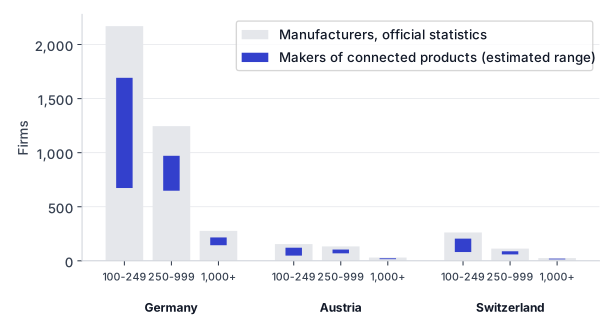
The population is small and concentrated. In Germany the 3,692 firms with 100 or more employees in electronics, electrical equipment, machinery and medical technology (WZ 26, 27, 28 and 32.5) make up about a third of the 11,359 legal units in these industries with 20 or more staff. Yet they employ 1.77 million of the 2.11 million people working there, or 84 %.367 The 100-249 band holds most firms but the lowest share of makers of connected products. Our estimate is least certain there, with a range of 673 to 1,692 German makers of connected products (Section A.3).37, 190, 367
- Connected functions are standard in larger firms. The large majority of the 100 surveyed German industrial companies with products with digital elements (94 %) already offer updatable products.331 Of 555 surveyed manufacturers with 100 or more employees, 45 % use IoT platforms and another 33 % plan to.37
- Implementation depends on company size. Half of the surveyed firms have started active CRA implementation, 59 % of those with 500 or more employees and 37 % of the smaller ones. As many have no dedicated external reporting channel for vulnerabilities, although the reporting duty already applies.330, 331
- Software bills of materials are mostly missing. Of 200 surveyed German industrial companies, 18 % have a software bill of materials (SBOM) for all affected products, 39 % have at least partially inventoried their software and 24 % have done nothing.307 Only 46 % are familiar with the CRA.307
- Awareness is low across the economy. Of 1,003 surveyed German companies with 10 or more employees, 29 % know what the CRA means for them.36 More than a quarter (28 %) have never heard of it.36
Connected-product regulation is not a project for December 2027 but already demands a working reporting process for devices that have been sold. Design decisions for products entering development now are made without standards to guide them. The next chapter shows what the five acts require of the device itself.
Sources in this chapter36
Numbered as in the full reference list and the PDF.
- [36] Bitkom e.V. (2026). Cyber Resilience Act: Nur 3 von 10 Unternehmen sind vorbereitet. https://www.bitkom.org/Presse/Presseinformation/Cyber-Resilience-Act-3-von-10-Unternehmen-vorbereitet
- [37] Bitkom e.V. (2026). Industrie 4.0 - Wie digital ist Deutschlands Industrie? (Präsentation 2026). https://www.bitkom.org/sites/main/files/2026-04/bitkom-praesentation-industrie-4-0-wie-digital-ist-deutschlands-industrie-2026.pdf
- [48] Bundesamt für Kommunikation BAKOM. (2025). Statistical observatory: the telecommunications sector in figures. https://www.bakom.admin.ch/en/statistical-observatory
- [54] Bundesamt für Sicherheit in der Informationstechnik. (2026). Technische Richtlinie BSI TR-03183: Cyber-Resilienz-Anforderungen an Hersteller und Produkte (Teil 1 v1.0.0, Teil 2 SBOM v2.1.0, Teil 3 v1.0.0, Teil H v1.1.0). https://www.bsi.bund.de/dok/TR-03183
- [56] Bundesamt für Statistik (BFS). (2026). Marktwirtschaftliche Unternehmen nach Wirtschaftsabteilungen und Grössenklasse (T 6.2.1.1), STATENT 2011-2024. https://dam-api.bfs.admin.ch/hub/api/dam/assets/36734571/master
- [78] Bundesnetzagentur. (2026). Jahresbericht Telekommunikation 2025. https://data.bundesnetzagentur.de/Bundesnetzagentur/SharedDocs/Mediathek/Jahresberichte/JB2025TK.pdf
- [82] CEN and CENELEC. (2026). CEN and CENELEC Work Programme 2026: Digital society. https://wp2026.cencenelec.eu/sectors-list/digital-society/
- [133] ENISA. (2026). The CRA Single Reporting Platform is launched. https://www.enisa.europa.eu/news/the-cra-single-reporting-platform-is-launched
- [134] Ericsson. (2026). Ericsson Mobility Report, June 2026: IoT connections outlook. https://www.ericsson.com/en/mobility-report/dataforecasts/iot-connections-outlook
- [136] ETSI. (2026). ETSI launches approval process for 17 European Standards supporting the Cyber Resilience Act. https://www.etsi.org/newsroom/press-releases/etsi-launches-approval-process-for-17-european-standards-supporting-the-cyber-resilience-act/
- [138] European Commission. (2003). Commission Recommendation 2003/361/EC concerning the definition of micro, small and medium-sized enterprises. https://eur-lex.europa.eu/eli/reco/2003/361/oj
- [141] European Commission. (2022). Commission Delegated Regulation (EU) 2022/30 supplementing Directive 2014/53/EU (RED) with regard to cybersecurity. https://eur-lex.europa.eu/eli/reg_del/2022/30/oj
- [145] European Commission. (2023). Commission Delegated Regulation (EU) 2023/2444 amending Delegated Regulation (EU) 2022/30 as regards the date of application. https://eur-lex.europa.eu/eli/reg_del/2023/2444/oj
- [147] European Commission. (2025). Annexes to the Commission Implementing Decision on a standardisation request to CEN, Cenelec and ETSI as regards products with digital elements in support of Regulation (EU) 2024/2847, C(2025) 618 final, 3 February 2025 (M/606). https://ec.europa.eu/transparency/documents-register/api/files/C(2025)618_1/de00000001069729
- [148] European Commission. (2025). Commission Implementing Decision (EU) 2025/138 amending Implementing Decision (EU) 2022/2191 as regards harmonised standards for cybersecurity of radio equipment. http://data.europa.eu/eli/dec_impl/2025/138/oj
- [151] European Commission. (2025). Cyber Resilience Act: standardisation. https://digital-strategy.ec.europa.eu/en/policies/cra-standardisation
- [153] European Commission. (2025). Proposal for a Regulation of the European Parliament and of the Council amending Regulations (EU) 2016/679, (EU) 2018/1724, (EU) 2018/1725, (EU) 2023/2854 and Directives 2002/58/EC, (EU) 2022/2555 and (EU) 2022/2557 as regards the simplification of the digital legislative framework, and repealing Regulations (EU) 2018/1807, (EU) 2019/1150, (EU) 2022/868, and Directive (EU) 2019/1024 (Digital Omnibus), COM(2025) 837 final. http://publications.europa.eu/resource/cellar/ebf17714-c56e-11f0-8da2-01aa75ed71a1.0001.02/DOC_1
- [154] European Commission. (2026). Commission Delegated Regulation (EU) 2026/339 of 16 February 2026 repealing Delegated Regulation (EU) 2022/30 (OJ L, 2026/339, 29.4.2026). https://eur-lex.europa.eu/eli/reg_del/2026/339/oj
- [155] European Commission. (2026). Commission Implementing Decision (EU) 2026/2015 of 4 September 2026 amending and repealing Implementing Decision (EU) 2023/1586 as regards harmonised standards for machinery drafted in support of Directive 2006/42/EC. https://eur-lex.europa.eu/eli/dec_impl/2026/2015/oj
- [156] European Commission. (2026). Cyber Resilience Act - Reporting obligations (last update 11 September 2026). https://digital-strategy.ec.europa.eu/en/policies/cra-reporting
- [159] European Commission. (2026). Harmonised standards: Machinery (MD). https://single-market-economy.ec.europa.eu/single-market/goods/european-standards/harmonised-standards/machinery-md_en
- [161] European Commission. (2026). NANDO: Regulation (EU) 2024/2847 (Cyber Resilience Act), notifications and notifying authorities. https://webgate.ec.europa.eu/single-market-compliance-space/notified-bodies/notifying-authorities?filter=legislationId:167953
- [167] European Parliament and Council. (2023). Corrigendum to Regulation (EU) 2023/1230 on machinery (OJ L 169, 4.7.2023, p. 35): application dates corrected to 20 January 2027 and 20 January 2024. https://eur-lex.europa.eu/eli/reg/2023/1230/corrigendum/2023-07-04/oj
- [168] European Parliament and Council. (2023). Regulation (EU) 2023/1230 on machinery (Machinery Regulation). https://eur-lex.europa.eu/eli/reg/2023/1230/oj
- [169] European Parliament and Council. (2023). Regulation (EU) 2023/1542 concerning batteries and waste batteries (battery passport). https://eur-lex.europa.eu/eli/reg/2023/1542/oj
- [170] European Parliament and Council. (2023). Regulation (EU) 2023/2854 on harmonised rules on fair access to and use of data (Data Act). https://eur-lex.europa.eu/eli/reg/2023/2854/oj
- [171] European Parliament and Council. (2024). Regulation (EU) 2024/2847 on horizontal cybersecurity requirements for products with digital elements (Cyber Resilience Act). https://eur-lex.europa.eu/eli/reg/2024/2847/oj
- [174] European Parliament, Legislative Observatory. (2026). Procedure file 2025/0360(COD): Simplification of the digital legislative framework, Digital Omnibus (Omnibus VII). https://oeil.europarl.europa.eu/oeil/en/procedure-file?reference=2025/0360(COD)
- [175] Eurostat. (2026). Enterprise statistics by size class and NACE Rev. 2 activity (from 2021 onwards), dataset sbs_sc_ovw. https://ec.europa.eu/eurostat/databrowser/view/sbs_sc_ovw/default/table
- [190] Fraunhofer-Institut für System- und Innovationsforschung ISI. (2020). Digitale Plattformen im Verarbeitenden Gewerbe (Mitteilungen aus der ISI-Erhebung Modernisierung der Produktion, Nr. 77). https://www.isi.fraunhofer.de/content/dam/isi/dokumente/modernisierung-produktion/erhebung2018/PI_77_B2B_Plattformoekonomie.pdf
- [307] ONEKEY GmbH. (2026). IoT & OT Cybersecurity Report 2026. https://www.onekey.com/resource/onekey-iot-ot-cybersecurity-report-2026
- [330] PwC Deutschland. (2026). Product Security Survey 2026: Digital vernetzt, aber auch sicher? https://www.pwc.de/de/cyber-security/product-cyber-security/pwc-product-security-survey-2026.html
- [331] PwC Deutschland. (2026). Trotz Meldepflichten: Nur 3 % der deutschen Industrieunternehmen sind vollständig auf EU Cyber Resilience Act vorbereitet. https://www.pwc.de/de/pressemitteilungen/2026/nur-3-prozent-der-deutschen-industrieunternehmen-sind-vollstaendig-auf-eu-cyber-resilience-act-vorbereitet.html
- [337] Rundfunk und Telekom Regulierungs-GmbH (RTR). (2024). RTR Telekom Monitor Jahresbericht 2023. https://www.rtr.at/TKP/aktuelles/publikationen/publikationen/m/tm/RTR_Telekom_Monitor_Jahresbericht-2023.pdf
- [338] Rundfunk und Telekom Regulierungs-GmbH (RTR). (2026). RTR Telekom Monitor Jahresbericht 2025. https://www.rtr.at/TKP/aktuelles/publikationen/publikationen/m/tm/RTR_Telekom_Monitor_Jahresbericht-2025_ua.pdf
- [367] Statistisches Bundesamt (Destatis). (2025). Statistischer Bericht - Kostenstrukturerhebung im Verarbeitenden Gewerbe sowie im Bergbau und der Gewinnung von Steinen und Erden - 2023 (Tabelle 42251-01: Rechtliche Einheiten nach Wirtschaftszweigen und Beschäftigtengrößenklassen). https://www.destatis.de/DE/Themen/Branchen-Unternehmen/Industrie-Verarbeitendes-Gewerbe/Publikationen/Downloads-Struktur/statistischer-bericht-kostenstruktur-2040430237005.html