Chapter 3 of 8
3Cost per device
A maker of connected products pays for radio, cloud and security month after month for the whole life of its fleet, and has to build that cost into its price. In the base case, the connectivity and security layer costs €0.50-3.10 per device per month, not counting the host product. Security accounts for €0.40-0.48 of it in every archetype, and only fleet size moves that amount by much. The chapter looks in detail at the base cost and the security premium, puts the cost of the Cyber Resilience Act (CRA) and the Data Act in proportion, and shows how fleet size, radio choice and product class change the premium.
3.1 Monthly running cost
For this report we built a cost model of our own. It calculates four archetypes: a battery tool with a BLE tracker, a machine with a cellular gateway, a building device under § 14a EnWG and a logistics tracker. The model covers the connectivity and security layer from the radio chip to the conformity assessment at published list prices, but not the host product’s motor, battery, enclosure and main controller. We spread one-off costs per device, such as chips, SIM packages and certificates, over 60 months. We spread one-off costs per product, such as secure development, documentation and conformity assessment, over all devices of the fleet and over 60 months, and monthly fees at fleet level, such as a certificate authority (CA) or a tooling subscription, over all devices of the fleet. The base case is 10,000 units over five years (line items, assumptions and sensitivity in Appendix C).
In our model a compliant battery tool costs €0.50 a month in the base case and the machine €3.10. The building device lies in between at €0.59, the logistics tracker at €0.99. For the machine, the cellular tariff and the always-on cloud traffic together make up almost four fifths of the total (€2.44 of €3.10). The radio therefore sets the total (Figure 4).
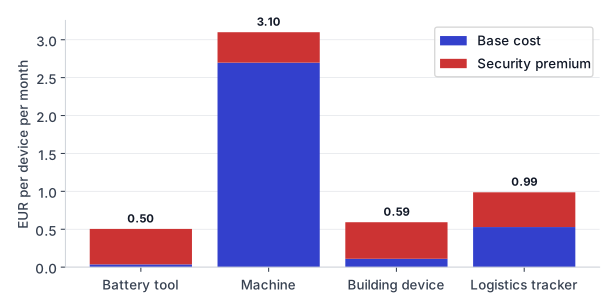
Source: RUBINLAKE cost model.
The security premium, by contrast, costs almost the same for every archetype, €0.40-0.48 per device per month. It covers the secure element, the public key infrastructure (PKI), signed over-the-air (OTA) updates, software bill of materials (SBOM) and vulnerability tooling, secure development, documentation and conformity assessment. Because the premium barely varies, its weight depends on the base. It is 13 % of the machine’s monthly cost but 93 % of the battery tool’s (Table 6). For devices without a SIM, compliance costs more than connectivity; for devices with one, the tariff matters more than the law.
| Archetype | Base cost (EUR/month) | Security premium (EUR/month) | Total (EUR/month) | Premium over 5 years per unit (EUR) | Premium share (%) |
|---|---|---|---|---|---|
| Battery tool with BLE tracker | 0.04 | 0.47 | 0.50 | 28.06 | 93 |
| Machine with gateway | 2.70 | 0.40 | 3.10 | 24.09 | 13 |
| Building device under § 14a EnWG | 0.11 | 0.48 | 0.59 | 28.92 | 81 |
| Logistics tracker | 0.53 | 0.46 | 0.99 | 27.49 | 46 |
Note: rows may not add up because of rounding. Source: RUBINLAKE cost model.
3.3 Data Act cost at company level
The Data Act adds cost per company, not per device. The Commission caps the cost of making product data accessible at €300,000 a year per small or medium-sized enterprise (SME) and €1 million per large company.143 For the whole IoT market it estimates €410 million one-off and €88 million a year, and it gives no cost per product.143
Spread over a fleet, the cap can exceed the whole security premium. An SME at the €300,000 ceiling would carry €2.50 per device per month at 10,000 units. A large company spreading €1 million over 100,000 devices would carry €0.83.143 Where a product already exports its data through a documented cloud API, the cost per device should be a fraction of these bounds.
3.4 Security cost over the lifecycle
Over five years the security premium in our model comes to €24-29 per unit, from €24.09 for the machine to €28.92 for the building device. It has four parts:
- Signed OTA: about half the premium. Golioth’s USD 0.25 per device per month is €0.22, or 48 % of the battery tool’s premium.199 On AWS IoT Device Management the machine’s OTA costs €0.15 a month, most of it for secure tunnels rather than update jobs.16
- CRA compliance per product: €0.175 a month.
- PKI: €0.04 a month. The USD 400 monthly fee of AWS Private CA is shared across the fleet. Certificates cost USD 0.35-0.75 each up to 10,000.19
- Secure hardware: under €0.05 a month, or €1.13-2.56 per unit once.112, 114
The secure element is the smallest item. At reel prices the ATECC608B costs USD 0.725 at 3,000 units, the STSAFE-A110 USD 1.27 at 5,000 and the SE050C2 USD 2.87 at 3,000.108, 112, 114 The pre-provisioned Trust&GO variant costs USD 1.91, more than twice the bare part. The difference pays for factory key injection.108 Saving on the chip saves a few cents a month. The running services decide the lifetime cost.
3.5 Fleet size as the main cost driver
Fleet size matters more than any component. In our model the security premium rises to about €2.30 per device per month at 1,000 units (€2.30-2.38), about five times the base case. At 100,000 units it falls below €0.30 (€0.21-0.29). In the small fleet, the per-product compliance block is spread over a tenth of the devices. The USD 400 monthly CA fee alone then comes to €0.36 per device.19 Two measures cut the PKI part: AWS’s short-lived certificate mode at USD 50 a month,19 or one CA shared across all of a manufacturer’s product lines.
At 100,000 units OTA becomes the largest part of the premium. The choice of update service then matters more than any other line. Azure Device Update costs USD 0.07 per device per month,266 nRF Cloud from USD 0.10285 and Golioth USD 0.25.199 balena charges USD 2.00 per additional device, almost thirty times Azure’s rate.28
Radio choice changes the base, not the premium. For the machine, Swisscom’s CMP Mobile Lite at CHF 1.00 lowers the base from €2.70 to €1.70, but includes no roaming.376 For the building device, LTE-M instead of the customer’s Wi-Fi raises the base from €0.11 to €0.57, with an nRF9151 and Telekom’s LPWA package at €14.50.96 For the tracker, LoRaWAN on The Things Stack costs about the same per month as LTE-M (€0.52 against €0.53) but needs its own GNSS chip (MAX-M10S, USD 9.33 at 500).115, 385 LoRaWAN reaches trailers and containers only within range of own or roaming gateways.385 A Myriota satellite plan on top of LTE-M raises the base to €1.41 before the satellite modem, for which Myriota publishes no price.274
Product class changes little per device. Third-party assessment at the Commission’s average of €25,000 adds €0.011 a month to the premium in the base case.144 At €50,000, the Commission’s estimate for software-heavy radio equipment, it adds €0.053.140 The premium falls by €0.036 if half of the secure-development cost is already business as usual.144 The product class is a question of lead time, not of cost per device.
It is not the security the law requires that makes a connected product expensive, but a small fleet, a cellular tariff and a separate backend for each product line. Product planning and purchasing fix these items before any harmonised standard exists. The next chapter shows which components and which architecture lie behind these costs.
Sources in this chapter20
Numbered as in the full reference list and the PDF.
- [16] Amazon Web Services. (2026). AWS IoT Device Management pricing. https://aws.amazon.com/iot-device-management/pricing/
- [19] Amazon Web Services. (2026). AWS Private CA pricing. https://aws.amazon.com/private-ca/pricing/
- [28] balena. (2026). balena pricing. https://www.balena.io/pricing
- [96] Deutsche Telekom. (2026). IoT and M2M data plans: IoT Business Classic, LPWA and Data Best. https://iot.telekom.com/en/iot-connectivity/iot-data-plans
- [100] Deutscher Bundestag. (2026). Gesetzentwurf der Bundesregierung zur Durchführung der Verordnung (EU) 2024/2847 (Cyber Resilience Act), Drucksache 21/6134. https://dserver.bundestag.de/btd/21/061/2106134.pdf
- [108] DigiKey. (2026). Microchip ATECC608B-MAHDA-S and ATECC608B-TNGTLSS-B. https://www.digikey.com/en/products/result?keywords=ATECC608B
- [112] DigiKey. (2026). NXP SE050C2HQ1/Z01SDZ. https://www.digikey.com/en/products/result?keywords=SE050C2HQ1
- [114] DigiKey. (2026). STMicroelectronics STSAFA110DFSPL02. https://www.digikey.com/en/products/result?keywords=STSAFA110
- [115] DigiKey. (2026). u-blox MAX-M10S-00B. https://www.digikey.com/en/products/result?keywords=MAX-M10S-00B
- [140] European Commission. (2021). Impact assessment accompanying Commission Delegated Regulation (EU) 2022/30 (Radio Equipment Directive, Article 3(3)(d), (e) and (f)), SWD(2021) 302 final. https://publications.europa.eu/resource/cellar/bc0a31a7-38a0-11ec-8daf-01aa75ed71a1.0001.02/DOC_1
- [142] European Commission. (2022). Executive summary of the impact assessment report, SWD(2022) 283 final. https://ec.europa.eu/newsroom/dae/redirection/document/89553
- [143] European Commission. (2022). Impact assessment report accompanying the proposal for a Data Act, SWD(2022) 34 final. https://publications.europa.eu/resource/cellar/490c2d61-961f-11ec-b4e4-01aa75ed71a1.0001.02/DOC_1
- [144] European Commission. (2022). Impact assessment report accompanying the proposal for a Regulation on horizontal cybersecurity requirements for products with digital elements, SWD(2022) 282 final. https://ec.europa.eu/newsroom/dae/redirection/document/89545
- [199] Golioth. (2026). Golioth pricing. https://golioth.io/pricing
- [266] Microsoft. (2026). Azure IoT Hub and Device Update for IoT Hub retail prices. https://azure.microsoft.com/en-us/pricing/details/iot-hub/
- [274] Myriota. (2026). Myriota enquiries: satellite data plans. https://myriota.com/enquiries
- [285] Nordic Semiconductor. (2025). Nordic launches full device observability and OTA capabilities via nRF Cloud by Memfault. https://www.nordicsemi.com/Nordic-news/2025/09/Nordic-launches-full-device-observability-and-OTA-capabilities-via-nRF-Cloud-by-Memfault
- [359] Serma Safety & Security. (2026). Cybersecurity guidance for the RED directive. https://www.serma-safety-security.com/en/cybersecurity/cybersecurity-guidance-for-red-directive/
- [376] Swisscom. (2026). IoT Webshop: CMP Mobile and CMP LPN. https://www.swisscom.ch/de/business/enterprise/angebot/iot/iot-connectivity/iot-webshop.html
- [385] The Things Industries. (2026). The Things Stack Cloud plans. https://www.thethingsindustries.com/stack/plans/